


Entertainment Tax in India
Entertainment tax is levied by the government on commercial shows, movie tickets, sporting events, music festivals, amusement parks, exhibitions, theatre shows, and other private festivals. Entertainment tax varies from state to state. Entertainment tax comes under the category of indirect tax.
Note: Entertainment tax has been replaced by the Goods and Services Tax (GST) starting 1 July 2017.
Taxation is an essential feature of the governance model of any country. Various kinds of taxes are applicable on goods and services bought and sold by individuals and enterprises. Tax is also levied on income earned by different individuals and business houses. Entertainment tax is a sort of tax levied by the government on movie tickets, commercial shows (large scale) and other private festival celebrations.
Features of Entertainment Tax in India
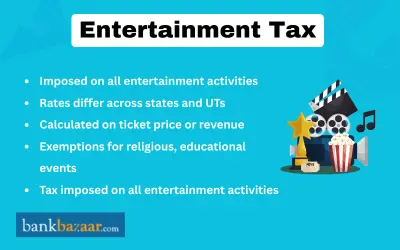
Entertainment tax forms a part of the tickets that we buy for watching movies or big entertainment shows.
Some of most prominent features of term insurance plans are listed below:
- Entertainment tax is applicable to some or the other form of entertainment throughout the country and is a part of the various costs borne by customers
- State governments are the authorities responsible for collection of entertainment tax from customers
- Entertainment tax in the country is different for different states since it is under the purview of the state governments
- Article 246 of the Indian constitution lists down all rules and guidelines that are applicable to the entertainment tax in India
- Paid television services like Dish TV and Tata Sky have led to further taxes being levied on entertainment
- Entertainment tax applies to the following categories of entertainment too:
- Exhibitions
- Activities related to sports
- Amusement Parks
- Arcades
- Celebrity Stage Shows
- Theatre Shows
- Video Games
- Entertainment tax was launched when the British Government ruled India, in order to curb public gatherings. However, the levying of the tax continued in the post-independence era too and still exists in all states of the country.
Entertainment Tax Rates in Various States
Entertainment tax was subsumed into GST for most forms of entertainment with effect from 1 July 2017. The rates below reflect the pre-GST entertainment tax structure that applied in various states before this transition; as of July 2026, cinema tickets and similar entertainment are taxed under the applicable GST slabs, with only limited local-body entertainment levies continuing in a few states.
Name of State | Tax Rate |
Maharashtra | 45% |
Uttar Pradesh | 60% |
Karnataka | 30% |
Kerala | 30% |
West Bengal | 30% |
Haryana | 30% |
Bihar | 50% |
Jharkhand | 110% |
Orissa | 25% |
Delhi | 20% |
MP | 20% |
Gujarat | 20% |
Andhra Pradesh | 20% |
Assam | 15% for tickets that cost less than Rs.20 and 20% for tickets that cost anything above Rs.20 |
Tamil Nadu | 15% (All Tamil films are tax-free in the state) |
Rajasthan | 0% |
Jammu & Kashmir | 0% |
Himachal Pradesh | 0% |
Punjab | 0% |

Disclaimer
Credit Card:
Credit Score:
Personal Loan:
Home Loan:
Fixed Deposit:


Copyright © 2026 BankBazaar.com.